Semrush alternatives: 50 options compared by type
Semrush is one of the most widely recognised names in search engine optimization software. According to the public data behind this directory, the company was founded in 2008, is headquartered in the United States, and its domain sits at Majestic rank 653, which puts it among the most heavily linked sites in the world. A product that large is rarely a perfect fit for everyone who uses it, and that is why a long list of substitutes exists.
This page collects 50 alternatives to Semrush and sorts them into ten types: direct competitors, budget-friendly tools, free options, enterprise-grade platforms, open-source projects, self-hosted software, regional specialists, built-in webmaster tools, adjacent products and do-it-yourself setups. Each type answers a different reason for leaving. Someone who wants a cheaper all-in-one suite needs a different shortlist from someone who only wants a rank tracker or someone who must keep data on their own server.
Everything here is based on public sources reviewed in November 2026. We did not run hands-on trials, and we do not list prices or feature tables, because those change often and are not part of our data. What we do give you is a structured map: who the alternatives are, where they come from, how prominent their domains are, and which ones we could confirm in a search review. Use it to build a shortlist, then check current plans and limits on each vendor's own site. The wider SEO tools category shows how these products relate to each other.
Semrush is available at semrush.com. Public records list Semrush as founded in 2008. Its headquarters country is recorded as United States. Its domain ranks #653 in the Majestic Million, a free public list of the most-linked-to domains on the web. Its domain ranks #2,169 in the Tranco list of the most visited domains.
This page lists 50 alternatives to Semrush, spread across 10 types: direct (11), budget (4), free (1), enterprise (7), open source (7), self-hosted (5), regional (8), built-in (2), adjacent (3), diy (2).
37 of the 50 entries were seen in live web search results during our November 2026 review; the remaining entries are labelled unconfirmed so you know where extra checking is needed.
Regional options cover Ukraine, Russia, Europe.
- Direct: 11 (22%)
- Budget: 4 (8%)
- Free: 1 (2%)
- Enterprise: 7 (14%)
- Open source: 7 (14%)
- Self-hosted: 5 (10%)
- Regional: 8 (16%)
- Built-in: 2 (4%)
- Adjacent: 3 (6%)
- DIY: 2 (4%)
37 of 50 entries (74%) were seen in live search results during our review; the rest are labelled “unconfirmed” and should be checked on the vendor site.
Quick comparison: the closest alternatives to Semrush
| Site | Name | Type | Founded | Majestic rank | Check |
|---|---|---|---|---|---|
 | SE Ranking | Direct | 2012 | #6,339 | seen in search |
 | Ahrefs | Direct | 2010 | #823 | seen in search |
 | Moz Pro | Direct | 2004 | #848 | seen in search |
 | Serpstat | Direct | 2013 | #17,519 | seen in search |
 | Search Atlas | Direct | n/a | #54,387 | seen in search |
What is Semrush and why do people look for alternatives?
Semrush is described in our data as an all-in-one suite covering SEO, pay-per-click research, content and AI-visibility tracking. In practice that means keyword research, competitor analysis, site audits, position tracking and reporting live inside one login. The company was founded in 2008 in the United States and, per press releases from Adobe, Adobe completed its purchase of Semrush on 28 April 2026 for roughly 1.9 billion USD. The brand has been kept and is being folded into Adobe's customer experience portfolio. It has not been closed or renamed.
People look for alternatives for a handful of recurring reasons. The first is breadth versus need: a suite that bundles dozens of modules can feel oversized when a team only tracks rankings or only audits a site. The second is the cost of entry, since a broad suite usually costs more than a narrower tool, which is worth checking against current plans. The third is ownership change. Any acquisition, including this one, prompts some customers to compare options, even though nothing in the public record says the product is going away.
Other motives are more practical. Agencies want white-label reports and client-friendly dashboards. Teams in Russia, Germany, Spain or East Asia want tools tuned to local search engines or languages. Privacy-minded groups want data on their own machines. Developers want an API and a database rather than a dashboard. Finally, plenty of small sites discover that the free data from Google Search Console and Bing Webmaster Tools covers most of what they actually act on.
The sections below walk through how we compiled the list, how to decide between types, and what to watch for during a move. If you are comparing several vendors in this space, the pages for Ahrefs and Moz Pro cover the same market from different starting points.
How we built this list
The list was compiled in November 2026 from public sources only. We combined the Majestic Million ranking for domain prominence, the Tranco list, Wikidata for founding years and headquarters, and a manual review of public web search results to see which products are actually presented as substitutes for Semrush. See the methodology page for licences and limits.
Each entry carries one of two statuses. Seen in search means we found the product described as an alternative or competitor in public search results during the review. Unconfirmed means it appears in our source data but we could not match it in that review; such entries are shown for completeness and are never offered as a top pick. Of the 50 entries here, 37 were seen in search and 13 are unconfirmed.
We sort entries into types because the word alternative hides very different trade-offs. A free webmaster tool, a desktop crawler and a Python script are all answers to the same question, but they are not interchangeable. The types are explained on their own hub pages, starting with direct alternatives and budget-friendly alternatives. We do not test products, rank them by quality or accept payment for inclusion.
How to choose a Semrush alternative
Start by writing down the three jobs you actually do in Semrush each week. For many teams the honest answer is narrower than the product: check rankings, look at a competitor's top pages, run an audit before a release. If your list is short, a focused tool will probably serve you better than another full suite. If your list is long and spans paid search, content and reporting, a direct competitor is the more natural replacement.
Next, decide how much of the data you need to be fresh and how much you can live without. Rank tracking depends on repeated checks of search results, backlink research depends on a crawler's index, and keyword volumes depend on a data provider. Different vendors invest in different parts of that chain, which is why the same domain can look slightly different in two tools. In our data, for example, Ahrefs is noted for strong backlink data and its own crawler, while Keyword.com is noted as a pure rank tracker with white-label options.
Finally, think about who will use the tool and where the output goes. A solo consultant needs a cheap plan and exports. An agency needs client seats, branded reports and scheduled emails. An in-house enterprise team needs access control, integrations with business intelligence tools and a vendor that will answer procurement questions. Read our guides for enterprise-grade options and self-hosted options if either of those describes you. These are the criteria worth weighing:
- Scope: do you need keyword research, backlinks, audits, rank tracking and ad research, or only one or two of them?
- Search markets: confirm the tool covers your countries, languages and search engines, not only Google in the United States.
- Reporting: white-label PDFs, scheduled emails and dashboards matter for agencies and for clients who never log in.
- Data ownership and export: check that you can get keywords, positions and history out in a usable format before you commit.
- Team model: look at how seats, projects and tracked keywords are counted, since limits are usually where plans differ.
- Integrations: Google Search Console, Google Analytics, business intelligence connectors and APIs can decide the choice.
- Vendor stability: note ownership changes, support channels and how long the product has existed.
Quick picks by situation
If you want the nearest like-for-like swap, begin with the direct suites: our data describes SE Ranking as a general-purpose toolkit that costs less than Semrush, and Serpstat as an inexpensive combined SEO, PPC and content tool. Ahrefs is the pick when backlink analysis is the main job, and Moz Pro suits agencies that value the long-standing Domain Authority metric and ready client reports.
If budget is the main constraint, Ubersuggest is described as the cheapest mass-market option and has a free plan, while Mangools offers keywords, rankings and SERP analysis at a low price. Ranktracker is another inexpensive set with a rank tracker. If you only track positions, a dedicated tracker such as Keyword.com or Pro Rank Tracker avoids paying for modules you will not open.
If you manage very large sites, look at the platforms in our enterprise list: Conductor, BrightEdge, seoClarity, Botify and Lumar. BrightEdge is noted for business intelligence integration and Botify for technical crawling at scale. If you want to avoid vendors altogether, Google Search Console gives free first-party data for your own site, and a Looker Studio dashboard can turn it into reports.
Developers and privacy-focused teams should look at open-source SerpBear for Google position tracking with notifications, or SEO PowerSuite, a desktop suite that keeps data local. Teams working in Russian-language markets will find Topvisor and Keys.so, while Sistrix is noted for its strong base in German-speaking markets. For deeper reading, compare Ahrefs and Surfer SEO, which attack different parts of the same job.
All 50 alternatives to Semrush by type
Direct alternatives to Semrush (11)
Products that solve the same core problem for the same kind of buyer. Switching usually means moving data and retraining people, not changing how you work. For Semrush, this list contains 11 entries in this group, including SE Ranking, Ahrefs, Moz Pro, Serpstat and Search Atlas. See all direct alternatives across every product →
Choosing among direct alternatives to Semrush
Direct alternatives are full or near-full SEO platforms that try to replace the same workflow. Our data lists 11, and 9 were seen in search. SE Ranking, founded in 2012 and based in the United Kingdom, is noted as a universal toolkit that is cheaper than Semrush. Ahrefs, founded in 2010 in Singapore, is known for backlinks and its own crawler. Moz Pro, founded in 2004 in the United States, brings the Domain Authority metric and agency reports. Serpstat from Ukraine is a low-cost combined SEO, PPC and content suite.
The remaining entries narrow the scope. Search Atlas is described as a suite with AI-visibility tracking at a lower price, Sitechecker combines audits, positions and Google Search Console and GA4 data, and Keyword.com, Pro Rank Tracker and Advanced Web Ranking focus on position tracking and reporting. SEOMonitor and Dragon Metrics are listed too, but we have not confirmed them in our search review. Browse the full direct alternatives hub to compare the type as a whole.
| Site | Name | Type | Founded | Majestic rank | Check |
|---|---|---|---|---|---|
| SE Ranking | Direct | 2012 | #6,339 | seen in search |
| Ahrefs | Direct | 2010 | #823 | seen in search |
| Moz Pro | Direct | 2004 | #848 | seen in search |
| Serpstat | Direct | 2013 | #17,519 | seen in search |
| Search Atlas | Direct | n/a | #54,387 | seen in search |
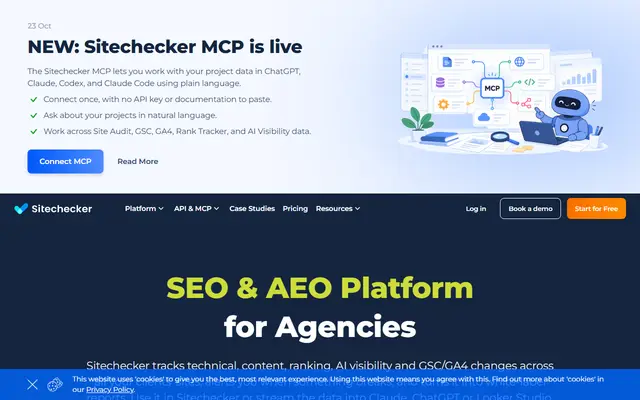 | Sitechecker | Direct | n/a | #26,049 | seen in search |
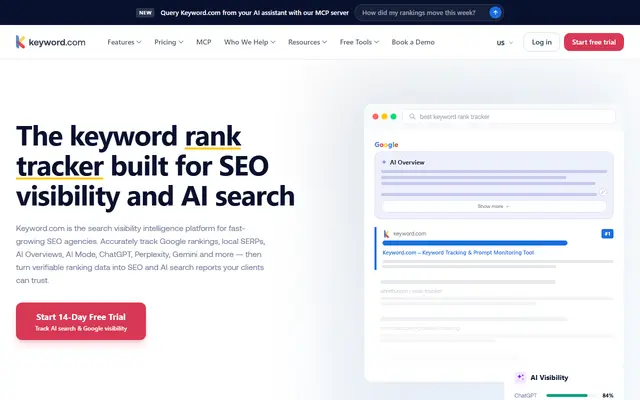 | Keyword.com | Direct | n/a | #100,226 | seen in search |
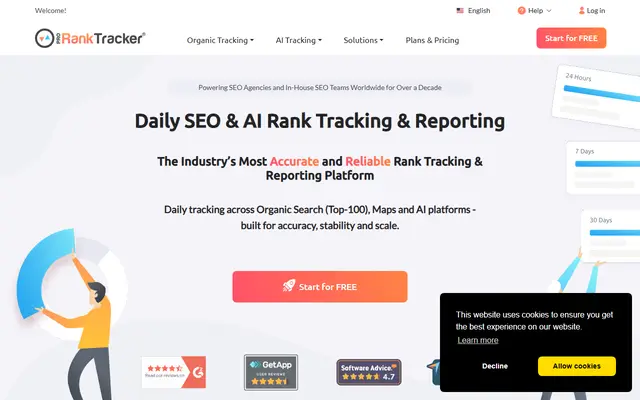 | Pro Rank Tracker | Direct | n/a | #139,805 | seen in search |
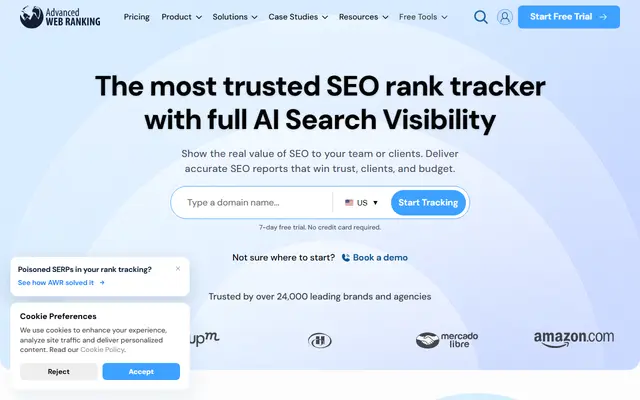 | Advanced Web Ranking | Direct | n/a | #23,528 | seen in search |
| SEOMonitor | Direct | n/a | #262,959 | unconfirmed | |
 | Dragon Metrics | Direct | n/a | #737,142 | unconfirmed |
Budget-friendly alternatives to Semrush (4)
Lower-cost tools that cover the essential jobs without the full feature surface. A good fit when you pay for seats or features you rarely open. For Semrush, this list contains 4 entries in this group, including Ubersuggest, Mangools (KWFinder, SERPWatcher), Ranktracker and Long Tail Pro. See all budget alternatives across every product →
Choosing among budget-friendly alternatives to Semrush
Budget-friendly tools trade breadth for price. Our data names four: Ubersuggest, Mangools (KWFinder and SERPWatcher), Ranktracker and Long Tail Pro. Ubersuggest is described as the cheapest mass-market tool and has a free plan. Mangools is described as inexpensive for keywords, positions and SERP analysis, and Ranktracker as a low-cost set that includes a rank tracker. Long Tail Pro is a keyword research tool, but it is unconfirmed in our search review.
The usual compromise is depth: smaller keyword databases, fewer tracked terms or lighter reporting. That is perfectly acceptable for a freelancer or a small shop, and a poor fit for a large multi-client agency. Check how each plan counts keywords and projects before you assume a low sticker price will stay low as you grow. Our budget alternatives hub lists more products of this kind across categories, and the Moz Pro page shows how a mid-priced classic compares.
Free options to Semrush (1)
Tools with a free plan or free access that is usable on its own. Limits on volume, users or history usually apply, so check them before you commit. For Semrush, this list contains 1 entry in this group, including Ahrefs Webmaster Tools. See all free alternatives across every product →
Choosing among free alternatives to Semrush
The free type has a single entry in our data: Ahrefs Webmaster Tools, described as a free audit and backlink view for sites you own. It is unconfirmed in our search review, so verify its current terms on the vendor's site before relying on it. Because it only covers properties you can verify, it works for monitoring your own site, not for studying competitors.
That limit is the main thing to understand about free tools in this space: they show you your own data. For competitor research you will need a paid product or one of the cheaper plans in the budget group. Free webmaster consoles from Google and Bing also exist and are covered under built-in options below. If you want to see how the free tier of one vendor fits into its wider product line, the Ahrefs page and the free alternatives hub are good places to continue.
| Site | Name | Type | Founded | Majestic rank | Check |
|---|---|---|---|---|---|
 | Ahrefs Webmaster Tools | Free | n/a | n/a | unconfirmed |
Enterprise-grade alternatives to Semrush (7)
Platforms built for large teams: governance, audit trails, integrations and support contracts. They tend to cost more and take longer to roll out. For Semrush, this list contains 7 entries in this group, including Similarweb, Conductor, BrightEdge, seoClarity and Botify. See all enterprise alternatives across every product →
Choosing among enterprise-grade alternatives to Semrush
Enterprise-grade platforms target large organisations with big sites and formal procurement. Our data lists seven, six of them seen in search. Similarweb, founded in 2007 in Israel, is noted for competitor traffic data and owns Rank Ranger. Conductor, founded in 2006 in the United States, is described as an enterprise platform that absorbed Searchmetrics. BrightEdge is noted for business intelligence integration, and seoClarity for being more transparent about pricing.
Botify focuses on technical crawling at scale and Lumar on technical SEO for large sites. STAT is an enterprise rank tracker, though we could not confirm it in our review. Expect sales-led buying, longer contracts and onboarding. Read the separate pages for BrightEdge and Similarweb for more detail, and see the enterprise hub for the type overall.
| Site | Name | Type | Founded | Majestic rank | Check |
|---|---|---|---|---|---|
 | Similarweb | Enterprise | 2007 | #1,728 | seen in search |
 | Conductor | Enterprise | 2006 | #7,967 | seen in search |
 | BrightEdge | Enterprise | n/a | #10,546 | seen in search |
 | seoClarity | Enterprise | n/a | #40,061 | seen in search |
 | Botify | Enterprise | n/a | #59,469 | seen in search |
 | Lumar | Enterprise | n/a | #51,140 | seen in search |
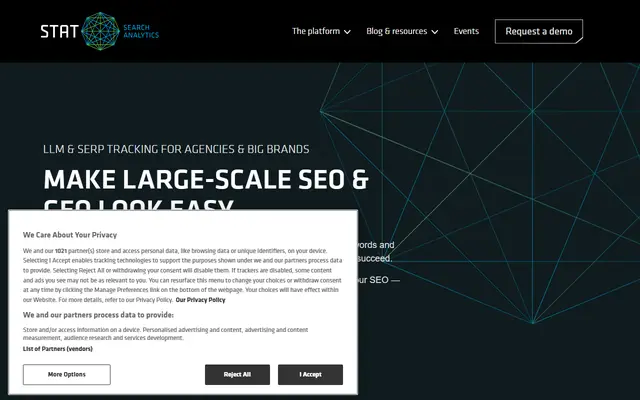 | STAT | Enterprise | n/a | #219,423 | unconfirmed |
Open-source alternatives to Semrush (7)
Projects whose source code is public. You can inspect, modify and often self-host them, at the price of doing more of the maintenance yourself. For Semrush, this list contains 7 entries in this group, including OpenSEO, SerpBear, Serposcope, SEOnaut and advertools. See all open source alternatives across every product →
Choosing among open-source alternatives to Semrush
Open-source options give you code you can inspect and run yourself. Our data lists seven, of which three were seen in search. OpenSEO is released under the MIT licence and needs a DataForSEO key. SerpBear tracks Google positions and sends notifications. Traffic Torch is described as an open, private SEO and UX set. Serposcope is an older open rank tracker, SEOnaut an open site auditor, advertools a Python library for SEO and SEM analytics, and Lighthouse or Unlighthouse an open speed and SEO audit; those four are unconfirmed in our review.
These projects are cheap in licence terms but not in effort. You provide hosting, updates and often a paid data source. They suit developers and technical SEOs who value control. They rarely replace client-facing reporting. See the open-source hub for the wider picture, and compare with the managed route described on the Surfer SEO page if content tooling is your main need.
| Site | Name | Type | Founded | Majestic rank | Check |
|---|---|---|---|---|---|
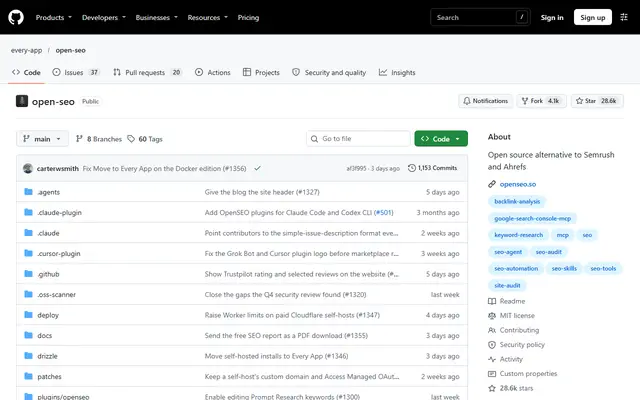 | OpenSEO | Open source | n/a | n/a | seen in search |
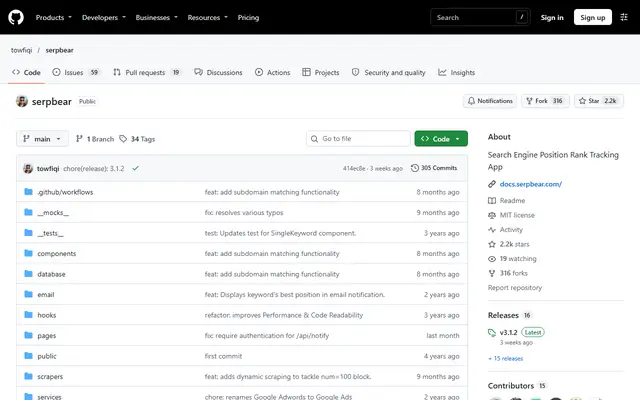 | SerpBear | Open source | n/a | n/a | seen in search |
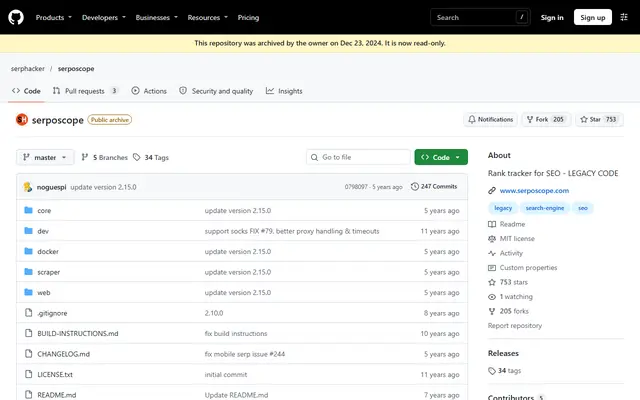 | Serposcope | Open source | n/a | n/a | unconfirmed |
 | SEOnaut | Open source | n/a | n/a | unconfirmed |
 | advertools | Open source | n/a | n/a | unconfirmed |
| Traffic Torch | Open source | n/a | n/a | seen in search | |
 | Lighthouse / Unlighthouse | Open source | n/a | n/a | unconfirmed |
Self-hosted alternatives to Semrush (5)
Software you run on your own server or computer. You keep control of the data and the uptime, and you take on updates, backups and security. For Semrush, this list contains 5 entries in this group, including SerpTrail (SerpApi), seo-command-center, SEO PowerSuite (Rank Tracker), Screaming Frog SEO Spider and Sitebulb. See all self-hosted alternatives across every product →
Choosing among self-hosted alternatives to Semrush
Self-hosted tools run on your own server or desktop, so your keyword lists and rankings stay under your control. Our data names five. SerpTrail from SerpApi is a Rails and SQLite tracker for SEO and GEO. seo-command-center is a Python platform that pulls data from DataForSEO. SEO PowerSuite with its Rank Tracker is a desktop set that stores data locally; its maker was founded in 2004 and is linked with Belarus in our data.
Screaming Frog SEO Spider and Sitebulb are desktop crawlers for audits, both unconfirmed in our search review. A desktop crawler will not give you backlinks or keyword volumes, so it complements rather than replaces a suite. The self-hosted hub lists comparable products in other categories, and the AccuRanker page covers a cloud tracker if you decide against running anything yourself.
| Site | Name | Type | Founded | Majestic rank | Check |
|---|---|---|---|---|---|
 | SerpTrail (SerpApi) | Self-hosted | n/a | #32,379 | seen in search |
| seo-command-center | Self-hosted | n/a | n/a | seen in search | |
 | SEO PowerSuite (Rank Tracker) | Self-hosted | 2004 | #14,513 | seen in search |
 | Screaming Frog SEO Spider | Self-hosted | n/a | #4,345 | unconfirmed |
 | Sitebulb | Self-hosted | n/a | #55,681 | unconfirmed |
Regional and local alternatives to Semrush (8)
Vendors that are strongest in a particular country or region: local languages, local payment methods, local data-residency rules and local support hours. For Semrush, this list contains 8 entries in this group, including Netpeak Spider, Topvisor, Pixel Tools, Keys.so and Sistrix. See all regional alternatives across every product →
Choosing among regional alternatives to Semrush
Regional tools are built around specific languages, search engines or markets. Our data lists eight. Netpeak Spider, from Ukraine, is a desktop crawler. Topvisor and Keys.so from Russia cover positions, semantics and competitors for the Russian-language web, and Topvisor is noted for Yandex. Pixel Tools is a Russian suite with more than 65 tools. Sistrix is noted for strong data in German-speaking markets, and DinoRANK is a Spanish-language set.
Seobility, described as a German audit and rank tool, and Xovi, a German suite, are not confirmed in our review. If your audience is in one of these markets, a regional tool may report local nuances better than a global suite. The trade-off is documentation, support language and integrations. The regional hub shows other products with a local focus, and the Seobility page has its own comparison.
| Site | Name | Type | Founded | Majestic rank | Check |
|---|---|---|---|---|---|
 | Netpeak Spider | Regional · Ukraine | n/a | #126,869 | seen in search |
 | Topvisor | Regional · Russia | n/a | #157,548 | seen in search |
| Pixel Tools | Regional · Russia | n/a | n/a | seen in search | |
 | Keys.so | Regional · Russia | n/a | #288,522 | seen in search |
 | Sistrix | Regional · Europe | n/a | #21,552 | seen in search |
 | Seobility | Regional · Europe | n/a | #19,931 | unconfirmed |
 | Xovi | Regional · Europe | n/a | #985,684 | unconfirmed |
 | DinoRANK | Regional · Europe | n/a | #588,848 | seen in search |
Built-in features of platforms you already use to Semrush (2)
Capabilities that already ship inside a suite or platform you pay for. They rarely match a specialist tool feature for feature, but they cost nothing extra. For Semrush, this list contains 2 entries in this group, including Google Search Console and Bing Webmaster Tools. See all built-in alternatives across every product →
Choosing among built-in alternatives to Semrush
Built-in here means tools supplied by the search engines themselves. Our data lists two, both seen in search: Google Search Console, described as free Google data about your own site, and Bing Webmaster Tools, which gives Bing data for your own site and was founded in 2009. Their Majestic ranks of 227 and 117 reflect how prominent the domains are, not how good the products are.
These consoles show real impressions, clicks and indexing issues for properties you can verify, which no third-party tracker can fully match. They do not show competitors, and their history and interfaces are limited. Many teams keep them alongside a paid suite, using the console as ground truth. If you are weighing whether you need a paid tool at all, begin here, then browse the built-in hub and the Google Keyword Planner page for keyword-side data.
Adjacent tools to Semrush (3)
Products that cover part of the job or approach it from another angle. Useful when you only need a slice of the original product. For Semrush, this list contains 3 entries in this group, including Surfer SEO, Keywords Everywhere and DataForSEO. See all adjacent alternatives across every product →
Choosing among adjacent alternatives to Semrush
Adjacent products do not replace Semrush wholesale but take over a specific part of what people use it for. Our data lists three, all seen in search. Surfer SEO optimises content against what ranks in search results. Keywords Everywhere shows keyword volumes directly in the browser. DataForSEO is an API for search result and keyword data and the usual base layer for do-it-yourself builds.
Choose an adjacent tool when one workflow, such as writing or data collection, is what you really needed. The risk is stacking several of them until the combined cost and effort exceed a single suite. Plan which tool owns which job. The adjacent hub collects similar products, and our page on Surfer SEO goes deeper on the content-optimisation side.
DIY and self-made approaches to Semrush (2)
Spreadsheets, scripts and workflows you assemble yourself. Cheap and flexible for small needs, but they depend on whoever built them. For Semrush, this list contains 2 entries in this group, including Python + SERP API and Looker Studio dashboard on GSC/GA. See all diy alternatives across every product →
Choosing among DIY alternatives to Semrush
DIY means building your own tracking from parts. Our data lists two, both seen in search. The first is a Python script with SQLite and a paid SERP API, a pattern many guides describe. The second is a Looker Studio dashboard assembled by hand from Google Search Console and Google Analytics data.
This route gives you exact control over keywords, schedules and storage, and it can cost very little if your needs are small. It also makes you the maintainer: when the API changes or a script breaks, nobody else will fix it. A sensible compromise is to use a data API such as DataForSEO under your own reporting layer. If you want to see how others approach this, read the DIY hub, and compare with the managed trackers on our AccuRanker page.
Migration checklist: moving away from Semrush
Switching tools is mostly a data-handling exercise, and doing it in order avoids gaps in reporting. Start before you cancel anything. Export everything you can while your current plan is active, and keep it somewhere neutral such as a shared drive. Then set up the new tool and let both run side by side for at least a full reporting cycle, so that you can compare numbers and explain any differences to stakeholders before the old subscription ends.
Expect numbers to differ. Two tools that both claim to check positions can use different locations, devices, data centres and timing, and keyword volumes come from different providers. That is normal and not a sign that either product is wrong. Agree on a baseline date, note it in your reports, and avoid comparing a month of one tool with a month of another without that caveat. Also remember that Semrush is now part of Adobe; if your contract or billing relationship changed with the acquisition, include that in your timeline. For other examples of planned moves in this category, see the Ahrefs page.
- Export tracked keywords with their target URLs, locations, devices and tags, and save historical position data as CSV.
- Save audit reports and issue lists, and note which issues are already fixed so you do not repeat work.
- Record your competitor sets and any custom groups or segments you rely on.
- Capture scheduled reports, white-label branding and recipient lists so you can rebuild them.
- Check integrations such as Google Search Console, Google Analytics and any dashboards that pull from the old tool.
- Run old and new tools in parallel for one reporting cycle and log the differences.
- Tell clients and colleagues which metric names change, for example authority scores, and when.
- Cancel the old plan only after exports are verified, and diarise the renewal date.
Mistakes to avoid when switching
The most common error is choosing a replacement on the strength of one feature that looked impressive in a demo. A tool can excel at backlinks and still be weak on the paid search research you used weekly. Write your must-have jobs down first and test each of them during the trial. Another frequent mistake is assuming that a cheaper plan will behave the same as the old one: limits on tracked keywords, projects, users and history are exactly where lower plans differ.
Teams also underestimate the human side. Reports, templates and habits are built around one interface, and a new one means retraining. Metric names are not interchangeable either; an authority score from one vendor is not the same number from another, and clients may notice if the scale changes without warning. Finally, avoid treating unconfirmed entries as safe bets. Several products in our list were not confirmed in our search review, so check their current status directly. For product-by-product comparisons, see the Moz Pro page.
- Picking by brand recognition instead of by the three jobs you actually perform.
- Skipping the export step and losing years of position history.
- Comparing numbers across tools without noting that data sources and methods differ.
- Ignoring plan limits on keywords, projects, seats and historical data.
- Cancelling the old subscription before the new tool has produced a full reporting cycle.
- Relying on an unconfirmed entry without checking that the product is still active.
What the public data says about these alternatives
Our data contains 50 alternatives. Of these, 37 were seen in search and 13 are unconfirmed. By type, the largest groups are direct (11), regional (8), enterprise (7) and open-source (7), followed by self-hosted (5), budget (4), adjacent (3), built-in (2), DIY (2) and free (1). The thin free group shows how rarely a free tool replaces a paid suite for competitor research.
Semrush itself was founded in 2008 and has a Majestic rank of 653 and a Tranco rank of 2169. Among the alternatives, Ahrefs sits at Majestic rank 823 and Moz Pro at 848, so the nearest rivals are comparably prominent. The built-in consoles rank higher still, with Bing Webmaster Tools at 117 and Google Search Console at 227. At the other end, the lowest-ranked entries include Dragon Metrics at 737,142 and Xovi at 985,684.
Where a founding year is known, the oldest alternatives are Moz Pro and SEO PowerSuite, both from 2004, followed by Conductor from 2006. The newest founding years in the data are SE Ranking in 2012 and Serpstat in 2013. Country information is partial: the United States appears seven times, Russia three, Singapore and Ukraine twice each, and Europe four times as a regional label. Treat these as signals about prominence and origin, not as measures of quality. The methodology page explains each source.
Frequently asked questions
What is the best free alternative to Semrush?
For your own site, Google Search Console and Bing Webmaster Tools are free first-party sources and were both seen in our search review. Ahrefs Webmaster Tools is also listed as a free audit and backlink view of your own site, though we could not confirm it. None of them shows competitor data the way a paid suite does.
Is there an open-source alternative to Semrush?
Yes. Our data lists OpenSEO, which is MIT-licensed and needs a DataForSEO key, SerpBear for Google position tracking, and Traffic Torch as an open, private SEO and UX set. Serposcope, SEOnaut, advertools and Lighthouse or Unlighthouse are also listed but not confirmed in our review. They need technical effort to run.
What is the cheapest alternative to Semrush?
Based on our public sources, Ubersuggest is described as the cheapest mass-market tool and has a free plan. Mangools and Ranktracker are also described as inexpensive. We do not list prices, so check each vendor's current plans, and compare limits on keywords and projects as well as the headline fee.
Which Semrush alternative is closest in features?
The direct group is the nearest match. SE Ranking is described as a universal set that costs less, Ahrefs is strong on backlinks, Moz Pro is an established suite with agency reports, and Serpstat is an inexpensive SEO, PPC and content combination. Match the choice to the modules you actually use.
Is Semrush shutting down after the Adobe deal?
Nothing we found says so. According to Adobe press releases, the purchase closed on 28 April 2026 for about 1.9 billion USD, and the Semrush brand has been kept and is being integrated into Adobe's customer experience offering. It has not been closed or renamed. Check vendor announcements for any later changes.
Can I export my data from Semrush before switching?
Most suites let you download keyword lists, reports and position history as files, but formats and limits vary by plan, so confirm what your plan allows. We do not verify export features. Export early, keep a copy outside the tool, and run old and new tools in parallel before cancelling.
Which alternatives suit rank tracking only?
If tracking positions is the main job, look at Keyword.com, Pro Rank Tracker and Advanced Web Ranking among direct tools, SerpBear if you want open source, and SEO PowerSuite for a local desktop approach. STAT is listed as an enterprise tracker but was not confirmed in our review.
Are there alternatives for Russian or German markets?
Yes. Topvisor, Pixel Tools and Keys.so come from Russia, with Topvisor noted for Yandex and Keys.so for competitors and keywords in the Russian-language web. Sistrix is noted for German-speaking markets, while Seobility and Xovi are German options that we could not confirm in our review.
Do I still need Google Search Console if I use a paid tool?
Generally yes. Search Console supplies first-party data about how Google shows and indexes your own site, which third-party trackers estimate rather than measure. Many teams keep it as the reference point and use a paid suite for competitor and market research.
Bottom line
Semrush remains a heavily linked, broad suite, and nothing in the public data suggests it is being withdrawn after the Adobe purchase. The reasons to look elsewhere are specific: you want to pay for fewer modules, you need a local-market specialist, you want data on your own hardware, or you prefer a stable, narrow tool for one job. Match the type to the reason and the shortlist shrinks quickly.
For most teams the practical path is a short list of three: one direct suite such as SE Ranking, Ahrefs or Moz Pro, one cheaper or narrower option, and the free search consoles as a baseline. Run them side by side, compare against your own export, and check current plans on each vendor site. Remember that entries marked unconfirmed need extra care. Continue with the Ahrefs page or the SEO tools category to compare further.
More alternatives pages related to Semrush
Where Semrush shows up as an alternative
Semrush appears in the alternatives lists of 9 other products: BrightLocal, rankingCoach, Google Keyword Planner, AgencyAnalytics, Ahrefs, SpyFu, AccuRanker, Seobility, BrandVerity. Comparing those lists shows which tools keep being recommended across the whole category.
Explore more in SEO & Search Tools
Keyword research, rank tracking, audits and content optimization. Browse the full SEO & Search Tools hub, or jump to a related comparison: BuiltWith, BrightLocal, rankingCoach, Google Keyword Planner, Ahrefs, SpyFu, AccuRanker, Seobility.