Marketing analytics and tracking alternatives, compared by type
Marketing analytics is not one product but a chain. Something collects events from websites and ads, something moves the numbers into one place, something turns them into charts for clients or managers, and something protects the spend from waste. Different vendors specialise in each link, which is why the replacement question has so many answers. This hub brings together our guides for six products that sit at different points on the chain.
The guides are Google Analytics, Supermetrics, AgencyAnalytics, Stape, ClickCease and BrandVerity. They contain 261 entries in total, sorted into ten types. Several names appear in two guides: DashThis, Whatagraph, Databox, Klipfolio, Swydo, Coupler.io, Windsor.ai, Porter Metrics, TapClicks, Improvado, Adverity and Domo link the AgencyAnalytics and Supermetrics guides, while Matomo, Swetrix and Piwik PRO link analytics guides, and Jitsu, RudderStack and Snowplow link the data-pipeline ones.
Everything comes from public sources reviewed in November 2026. We did not test any product and do not quote prices or data limits. Several entries in the ClickCease guide were added from memory rather than from a fresh search, as our data itself warns, so they are especially marked as needing verification. Measurement involves personal data, so privacy rules depend on your country; this is general information, not legal advice. See the methodology page for how the data was built.
- Direct: 25 (20%)
- Budget: 6 (5%)
- Free: 4 (3%)
- Enterprise: 21 (17%)
- Open source: 13 (11%)
- Self-hosted: 5 (4%)
- Regional: 7 (6%)
- Built-in: 9 (7%)
- Adjacent: 24 (20%)
- DIY: 8 (7%)
Marketing Analytics & Tracking guides: pick the product you want to replace
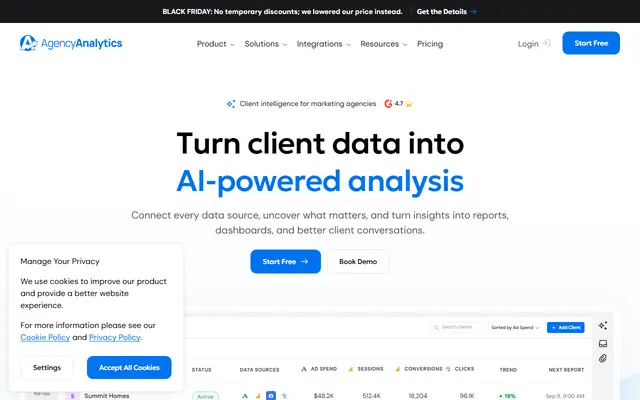
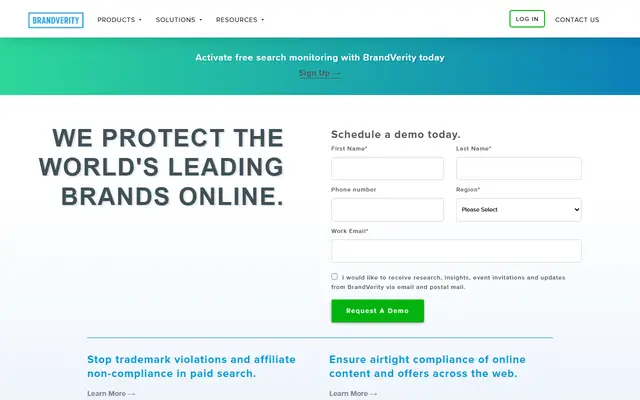
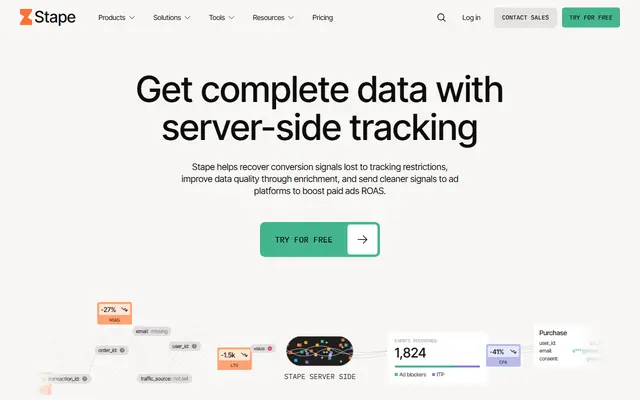
The analytics and tracking landscape
Web and product analytics answer what visitors did. Google Analytics is the default here, and its guide lists 50 alternatives, from privacy-focused cloud services such as Plausible, Fathom, Simple Analytics and Pirsch to open-source tools like Matomo, Umami, Rybbit and GoatCounter. Reporting and dashboard tools answer what clients need to see: AgencyAnalytics, DashThis, Whatagraph and Databox belong here. Connectors and pipelines move the numbers: Supermetrics, Windsor.ai, Coupler.io and Funnel.io are the names that recur.
Server-side tracking is a newer layer. Stape, founded in 2021 in the United States, hosts server-side Google Tag Manager containers, and its alternatives range from other managed hosts to self-run containers on a VPS or a cloud account. ClickCease and BrandVerity cover protection and compliance. In our data ClickCease is now called CHEQ Essentials and belongs to CHEQ, while BrandVerity monitors paid search and affiliate ad compliance and was bought by Partnerize in 2020.
By type, direct alternatives lead with 58 entries, followed by enterprise-grade platforms (40), adjacent products (38), open-source projects (35), built-in options (25) and regional tools (24). Do-it-yourself setups number 14, budget-friendly tools 11, free options 8 and self-hosted software 8. The enterprise group is large because data integration and tag management are sold to large organisations through sales teams.
How to choose a marketing analytics tool
Name the question each tool must answer. If the question is which pages visitors view and where they come from, you want an analytics platform. If it is how do I show ten clients their numbers every month, you want a reporting tool with templates and white labelling. If it is how do I bring advertising spend from eight platforms into one table, you want a connector or pipeline. Mixing these jobs leads to buying the wrong thing.
Size and staffing deserve attention as well. A two-person agency can live with a template-driven reporting tool and a spreadsheet connector, while a company with a data team may prefer a warehouse and an open-source pipeline it controls. Be wary of buying capacity you will not use, and equally wary of a tool whose limits on data sources, client accounts or history will bite after six months of growth.
Then examine data ownership. Hosted analytics from a large vendor is convenient, while open-source and self-hosted tools keep raw events on your servers. Consent rules and privacy law influence what you can collect and where it can be stored, so treat location and retention as selection criteria. Our open-source alternatives and self-hosted alternatives pages show how these options compare across categories. The criteria that matter most are:
- Job to be done: analytics, reporting, data movement, tag hosting or ad protection.
- Data sources: confirm the connectors you need exist for every ad and analytics platform you use.
- Privacy and consent: cookie-free approaches, regional hosting and consent-mode support.
- Reporting needs: white-label dashboards, scheduled delivery and client logins for agencies.
- Warehouse and export: ability to push data to BigQuery or another warehouse and take it back out.
- Operations: who maintains servers, tags and pipelines when something breaks.
- Vendor direction: renames, acquisitions and retirements noted in our status information.
Why teams replace analytics and tracking tools
Privacy is the main reason people leave a default analytics tool. The Google Analytics guide is dominated by privacy-oriented products, with 11 open-source entries and several regional services such as Yandex Metrica, Baidu Tongji and etracker. Others want simpler dashboards than a full event model offers and choose Plausible, Fathom or Simple Analytics.
Agencies replace reporting tools when per-client costs grow or when white labelling falls short, and they replace connectors when a data source is not supported or when the pipeline becomes expensive. That explains why the same dozen names connect the AgencyAnalytics and Supermetrics guides. Developers look at open-source pipelines such as Airbyte, Meltano and dlt.
Tracking accuracy drives the third reason. Browser restrictions reduce what client-side scripts can see, so teams adopt server-side tracking through Stape or its alternatives, and some compare managed hosts with running the container themselves. Finally, ownership change prompts comparison: ClickCease is now CHEQ Essentials, and BrandVerity has belonged to Partnerize since 2020. The enterprise-grade alternatives hub collects the large-platform route.
Cost structure is the last common trigger. Reporting tools often charge per client or per data source, connectors by volume or destination, and analytics platforms by event count, so growth changes the bill in different ways. Comparing two tools therefore means modelling your next twelve months, not today's numbers. The budget-friendly alternatives hub lists lower-cost options from every category.
About Google Analytics alternatives
Google Analytics is the default web analytics service, and its guide lists 50 alternatives. Plausible, Fathom Analytics, Simple Analytics and Pirsch are direct options, Matomo, Umami, Rybbit and GoatCounter are open source, and Vercel Web Analytics, Netlify Analytics and Jetpack Stats are built into hosting platforms. Enterprise-grade names include Adobe Analytics and Contentsquare. Compare all of them on the Google Analytics alternatives page.
About Supermetrics alternatives
Supermetrics, founded in 2013 in Finland with about 400 employees, moves marketing data into spreadsheets, warehouses and dashboards. Its guide lists 50 alternatives. Windsor.ai, Funnel.io, Coupler.io, Dataslayer and Porter Metrics are direct options, Improvado and Adverity are enterprise-grade, and Airbyte, Meltano and dlt are open source. Make, Zapier and n8n serve DIY builds. See the Supermetrics alternatives guide.
About AgencyAnalytics alternatives
AgencyAnalytics is a client reporting platform for marketing agencies. Its guide lists 50 alternatives. DashThis, Whatagraph, Databox, Klipfolio and Swydo are direct options, Coupler.io, Windsor.ai and Porter Metrics are budget picks, and TapClicks, Improvado, Funnel and Domo are enterprise-grade. Built-in routes include Looker Studio and Power BI. The AgencyAnalytics alternatives page sorts them all.
About Stape alternatives
Stape offers managed hosting for server-side Google Tag Manager and is listed as active in 2026. Its guide lists 36 alternatives. Addingwell, Tracklution, Edgee, Aimerce and Hardal are direct options, Jentis, Segment, mParticle, Tealium and Piwik PRO are enterprise-grade, and self-hosted routes include a Docker image on your own VPS. Cloudflare Zaraz is built-in. Open the Stape alternatives guide for details.
About ClickCease alternatives
ClickCease protects advertising budgets from invalid clicks and, per our data, is now called CHEQ Essentials within CHEQ. Its guide lists 39 alternatives, but most were not confirmed in our search review. Direct options include Fraud Blocker, ClickGUARD, TrafficGuard and ClickPatrol, while DoubleVerify and HUMAN Security appear at enterprise level. Google Ads IP exclusions are built in. Read the ClickCease alternatives page with care.
About BrandVerity alternatives
BrandVerity monitors paid search for brand and affiliate compliance and has belonged to Partnerize since 2020. Its guide lists 36 alternatives. The Search Monitor, AdPolice BrandProtect, Adthena and Bluepear are direct options, Red Points, MarkMonitor and Corsearch are enterprise-grade brand protection, and Meta Ad Library and Google Ads Transparency Center are free. See the BrandVerity alternatives guide, and the social and affiliate hub for related programmes.
Browse analytics & tracking alternatives by type
- Direct alternatives: 25 in this category. Products that solve the same core problem for the same kind of buyer. Switching usually means moving data and retraining people, not changing how you work.
- Budget-friendly alternatives: 6 in this category. Lower-cost tools that cover the essential jobs without the full feature surface. A good fit when you pay for seats or features you rarely open.
- Free options: 4 in this category. Tools with a free plan or free access that is usable on its own. Limits on volume, users or history usually apply, so check them before you commit.
- Enterprise-grade alternatives: 21 in this category. Platforms built for large teams: governance, audit trails, integrations and support contracts. They tend to cost more and take longer to roll out.
- Open-source alternatives: 13 in this category. Projects whose source code is public. You can inspect, modify and often self-host them, at the price of doing more of the maintenance yourself.
- Self-hosted alternatives: 5 in this category. Software you run on your own server or computer. You keep control of the data and the uptime, and you take on updates, backups and security.
- Regional and local alternatives: 7 in this category. Vendors that are strongest in a particular country or region: local languages, local payment methods, local data-residency rules and local support hours.
- Built-in features of platforms you already use: 9 in this category. Capabilities that already ship inside a suite or platform you pay for. They rarely match a specialist tool feature for feature, but they cost nothing extra.
- Adjacent tools: 24 in this category. Products that cover part of the job or approach it from another angle. Useful when you only need a slice of the original product.
- DIY and self-made approaches: 8 in this category. Spreadsheets, scripts and workflows you assemble yourself. Cheap and flexible for small needs, but they depend on whoever built them.
How the ten types apply to analytics and tracking
Direct alternatives replace the same job, such as one reporting tool for another, and make up the largest group. Budget-friendly and free tools suit small agencies and sites with simple needs. Enterprise-grade platforms such as Adobe Analytics, Snowplow, Tealium and Domo add governance and scale. Open-source and self-hosted tools keep data on your own servers but need engineering time.
Regional options respond to local search engines and privacy rules, and built-in options come with your cloud, hosting or website platform. Adjacent products cover a neighbouring need, such as audience research or e-commerce tracking. DIY routes use Google Sheets, scripts, Make, Zapier or n8n. A common pattern is to combine two types, for example open-source analytics plus a built-in dashboard layer. Compare how those fit on the built-in and DIY hubs.
Where several types fit, prefer the one that reduces your maintenance load. A managed direct alternative usually costs more per month than an open-source project but saves the hours spent on upgrades, and the reverse holds for teams with spare engineering capacity.
Pitfalls when changing analytics and reporting tools
Historic data is the biggest risk. A new analytics tool starts empty, and metrics are defined differently between products, so year-on-year comparisons break. Export or archive old data before the switch and annotate reports with the change date. Tracking changes also need testing: a tag moved to a server-side container can silently stop firing.
- Switching analytics without a parallel period, so there is no baseline to compare.
- Assuming metric names such as sessions or conversions mean the same thing across tools.
- Rebuilding client dashboards by hand without confirming that every connector exists.
- Ignoring consent and data-location rules when moving to a new vendor.
- Treating entries not confirmed in our review as proven, especially in the ad-protection guide.
Frequently asked questions
What is the best privacy-friendly alternative to Google Analytics?
Our guide lists Plausible, Fathom Analytics, Simple Analytics and Pirsch as direct options, with Matomo, Umami, Rybbit and GoatCounter as open-source or self-hosted routes. Which is best depends on whether you want hosted convenience or full control. Check consent rules and data location for your country.
What can replace Supermetrics?
Our data names Windsor.ai, Funnel.io, Coupler.io, Dataslayer and Porter Metrics as direct options, Improvado and Adverity at enterprise level, and Airbyte, Meltano and dlt as open-source pipelines. Check that every platform you pull from has a connector before moving.
Which tools compete with AgencyAnalytics?
DashThis, Whatagraph, Databox, Klipfolio and Swydo are the direct options in our data, with Looker Studio and Power BI as built-in routes. Metabase, Apache Superset and Grafana are open-source dashboards. Compare white labelling and client access on your own accounts.
Is there an alternative to Stape for server-side tagging?
Yes. Addingwell, Tracklution, Edgee, Aimerce and Hardal are listed as direct options, TAGGRS as a regional one, and you can run the official server container on your own VPS or cloud account. Self-hosting trades subscription cost for maintenance work.
What happened to ClickCease?
According to our data the product is now called CHEQ Essentials and belongs to CHEQ. Many alternatives in that guide were added without a fresh search, so they are not confirmed. Verify each vendor directly before choosing, and use Google Ads built-in exclusions as a baseline.
What are alternatives to BrandVerity?
The Search Monitor, AdPolice BrandProtect, Adthena and Bluepear are listed as direct options, with Red Points, MarkMonitor and Corsearch at enterprise level. Google Ads Transparency Center and Meta Ad Library are free sources for checking advertisers.
Can I build analytics reporting myself?
Yes, with Google Sheets plus connectors, Excel with Power Query, Python or Streamlit scripts, or Looker Studio. It costs little at small scale, but you become the maintainer of every connector and chart. Decide who fixes things when an API changes.
Do cookie-free analytics tools replace Google Analytics fully?
They cover traffic, sources and goals well but usually offer fewer advertising and audience features. Check whether you need ad-platform integrations, funnels or user-level analysis. Privacy rules differ by country, and this is general information, not legal advice.
Other categories
- CRM & Sales SoftwarePipeline management, customer records and sales automation.
- Lead Intelligence & ProspectingB2B contact data, enrichment, visitor identification and outreach.
- Email Marketing & DeliveryNewsletters, automation, transactional email and sending infrastructure.
- SEO & Search ToolsKeyword research, rank tracking, audits and content optimization.
- Social, Influencer & Affiliate MarketingSocial media management, influencer marketplaces and partner programs.
- Customer Support & MessagingHelp desks, shared inboxes, live chat and messaging platforms.
- IT Management & MonitoringService management, infrastructure monitoring, device management and remote access.
- Cloud, Hosting & InfrastructureVirtual servers, hosting providers, virtualization and edge networks.
- Payments, Spend & CryptoPayment processing, corporate cards, expense management and exchanges.
- Accounting & ERP SoftwareBookkeeping, invoicing and small-business ERP.
- HR & Global HiringHR information systems, employer-of-record and global payroll.
- Telephony, Video & CommunicationsCloud phone systems, contact centers, CPaaS and video hosting.
- Documents, Projects & ProductivityE-signature, proposals, project management, intranets and surveys.
- Data, Proxies & UtilitiesWeb data collection, proxy networks and system utilities.
- Everyday AlternativesAlternatives for fitness, cooking, car parts and legal streaming.
- Personal Finance & InvestingAlternatives to traditional student loans, investing platforms and credit scoring. General information only.